

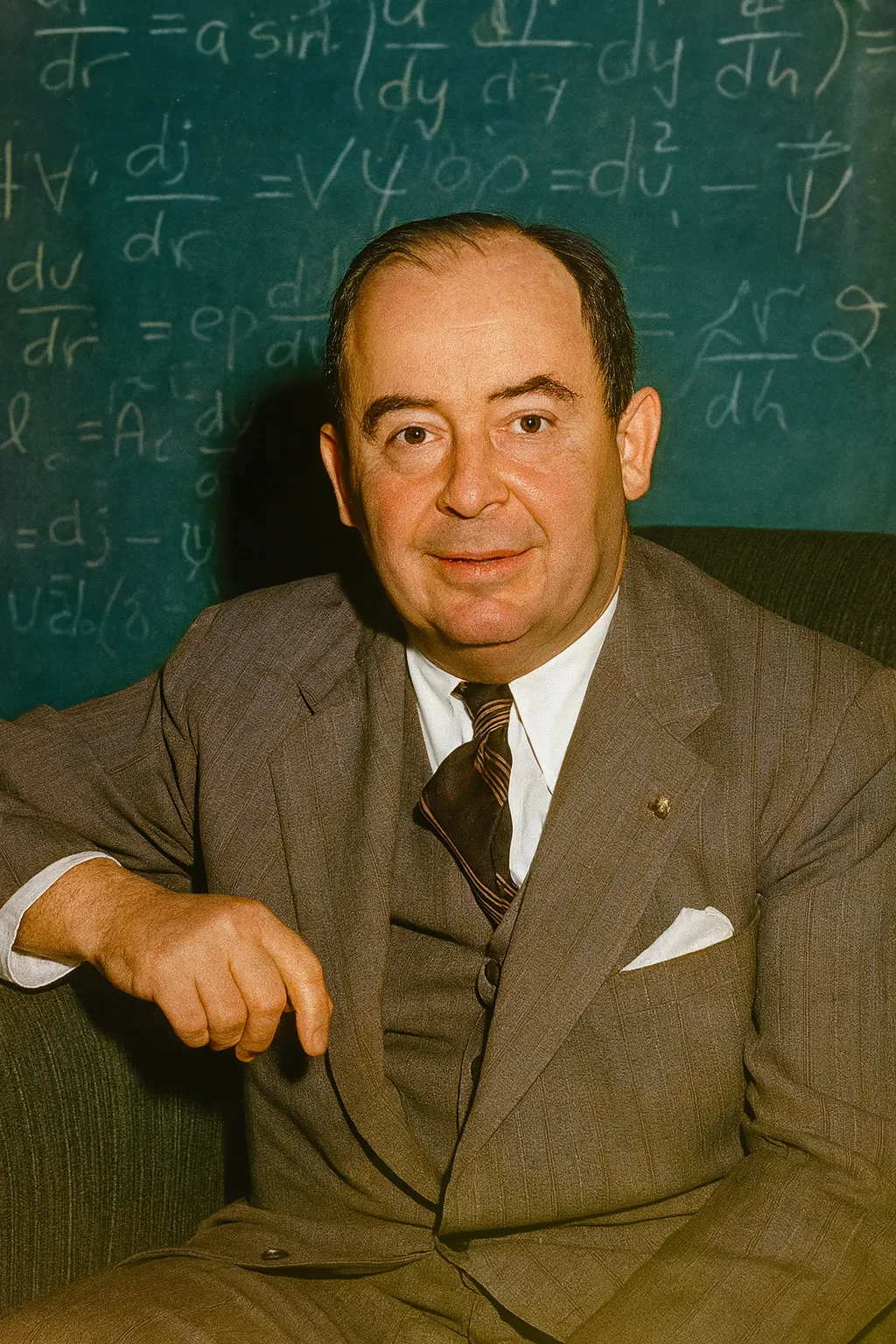
The John von Neumann Lecture honours developments in game theory of significant mathematical interest.
Recipients and lectures
2024 · Beijing, China World Congress
Françoise Forges
Paris Dauphine-PSL University
“On Repeated Games with Incomplete Information”
Lecture presented 21 August 2024.
Abstract
The lecture surveys equilibrium results for two-person undiscounted repeated games with one informed player, including joint-plan and Nash equilibria. It connects this analysis to static games with cheap talk, where communication and cooperation shape outcomes, and discusses extensions to imperfect monitoring, multiple informed players, and discounting.
2021 · Budapest, Hungary and online World Congress
Josef Hofbauer
University of Vienna
“(Dynamic) Stability of Nash Equilibria”
Lecture presented 19 July 2021.
Abstract
Which Nash equilibria of a bimatrix game are stable under replicator dynamics?
2016 · Maastricht, Netherlands World Congress
Sylvain Sorin
University of Paris VI (Pierre and Marie Curie)
“Asymptotic Value of Dynamic Games”
Lecture presented 26 July 2016.
Abstract
Long term strategic interactions in a stationary environment have usually been modeled as repeated games. At each stage of the process, the moves of the players determine the joint law of the new state and signals to the players and a stage-specific payoff. An evaluation that assigns a (for example, discounted) weight to each stage induces a total weighted payoff, hence a game, with a value that depends on the evaluation. Longer games, when the duration associated to the evaluation increases, correspond to vanishing stage weight, and the associated limit of the game values is the asymptotic value. We will describe recent advances involving new approaches and results (including cases of existence and non-existence of the limit). Another alternative approach for studying multistage interactions considers a continuous time process that the players observe and control at discrete times, corresponding to a partition. The asymptotic approach is the analysis of the game as the mesh of the partition decreases, thus with vanishing stage duration. We will present new developments in this direction and discuss the relation with differential games or more generally games in continuous time. In both frameworks the main tool is the recursive structure and the associate operator that extend the initial Shapley formula for finite discounted stochastic games.
2012 · Istanbul, Türkiye World Congress
Abraham Neyman
The Hebrew University of Jerusalem
- Jean-François Mertens · CORE, Université catholique de Louvain
“A Random Partition Approach to the Value, Stable Bridges of Index 1”
Lecture presented 26 July 2012.
2008 · Evanston, United States World Congress
Abraham Neyman
The Hebrew University of Jerusalem
Lecture presented 16 July 2008.